



Advanced Vedic Astrology — The Five-Year Professional Programme
For those who intend to practise













- CNN
- Gulf News
- The Wall Street Journal
- India TV
- The Republic TV
- NDTV India
- News Nation
- Zee TV
- Jaipur Dialogue
- PGurus
- Radio City
- Radio Mirchi
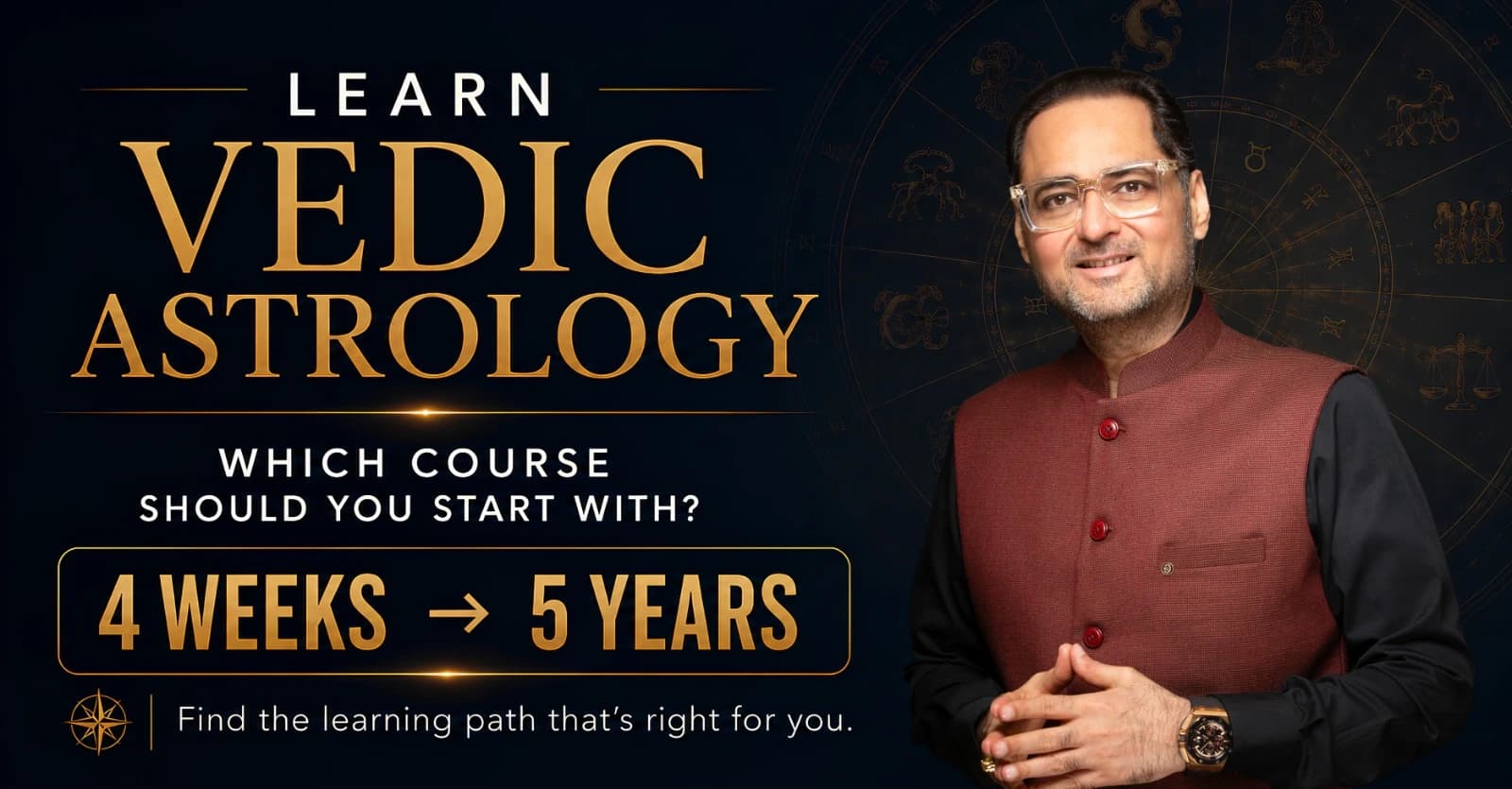
Five years, taught live by Kaartik personally, with every session recorded and available on Vedic Gurukul portal & APP!
The programme is running now, currently in its fourth year. That matters in two ways. It tells you this is a living classroom with a cohort in it, not a library of files someone uploaded once. And it means that from the day you enrol, every class already taught is waiting for you in the Vedic Gurukul portal — recorded, indexed, and yours to work through at your own pace while you join the live sessions from wherever the class currently is.
Your five years run from your start date, not from the cohort's calendar. You do not lose the years already covered and you do not wait for a new batch. Start when you are ready.
The structure runs in three stages.
5-YEAR COURSE AND SYLLABUS
Year One — Invoking Gaṇeśa
Forty-five recorded sessions, available now in the Vedic Gurukul portal.
Introduction to the Vargas
The divisional charts, and why one chart was never going to be enough. Where each varga applies, and what it shows you that the Rāśi cannot.
Viṣṇu Kendras and the Viṣṇu Avatāras
The kendra houses read through the avatāras — what each governs, and how the pattern is used in a live reading.
Planning your day from your own chart
Daily application. Which hours work for you and which do not — a working day arranged around your chart, not a generic Pañcāṅga.
Personal remedies
Remedies read from your own chart, matched to a planet and to a named problem, with the reasoning attached. You start with your own long before you prescribe for anybody else.
The karma a practitioner takes on — and the remedies for it
A chart is karma. Read enough of them and it accumulates. This is a karmic profession, not a hobby, and almost nobody says so out loud.
You will learn the self-remedies this parampara has used for more than five hundred years — what a practising Jyotiṣī does to protect themselves, when it is done, and why it matters more the busier you become.
It is taught early, before you begin reading for other people. Nobody hands you this in a book. It is one of the reasons a lineage exists.
Rudrākṣa, and remedies through rudrākṣa
Which mukhī, for whom, and why. How a rudrākṣa is chosen from a chart rather than from a shop — and what it is actually meant to shift.
The twelve lords and their effects — 144 combinations
This is the heart of Year One.
Each of the twelve lords, placed in each of the twelve houses. One hundred and forty-four combinations — and you will not memorise a single one of them.
You learn twelve principles and derive all one hundred and forty-four. That is how Jyotiṣa was built to work, and it is the reason a decade of memorising ślokas never got you there.
Also covered in Year One
Sudarśana Chakra Daśā, and its effect in the Navāṁśa
A daśā worked from three lagnas at once, and what it shows in the Navāṁśa that a single reading will miss.
Prāṇapada — effect and application
A sensitive point most students are never taught to calculate, and what it governs once you can.
Kālachakra and Dig Chakra
Direction, timing and movement — including the parts of both systems that rarely leave a classroom.
Year Two — Invoking Śiva
Forty-six recorded sessions available on Vedic Gurukul Portal & APP
Year One taught you to derive results from principles. Year Two teaches you where to look — which chart answers which question, and how to test an answer before you say it out loud.
Navāṁśa — the D9 — more than fifteen sessions
A third of the year on a single chart.
The Navāṁśa carries your bhāgya — what a life actually ripens into, as opposed to what it appears to promise on the surface. Marriage and the partner. Dharma. The real strength of a planet, as against the strength it seems to have in the Rāśi.
Almost every serious reading turns on this chart, and almost nobody is taught it properly. Fifteen sessions in, you will be reading it the way it was meant to be read — and confirming an event in the D9 before you ever commit to it in front of a client.
Daśāṁśa — the D10
Career, profession and standing. Where the work actually goes, which is not always where the tenth house says it should.
Chaturthāṁśa — the D4
Property, home and fixed assets. What you will hold, where, and whether it stays with you.
Dvādaśāṁśa — the D12
Parents and ancestry — what came down to you before you had any say in it.
Ṣaṣṭyāṁśa — the D60
The finest division in the system, and the one the classics weight most heavily. Past karma read at its most precise.
This is the chart that explains why a life is shaped the way it is when nothing else in the horoscope accounts for it.
Yogakāraka and Viśeṣa Yogakāraka
The planet that owns both a kendra and a trikoṇa, and what its presence does to a chart. Then the special cases — when a yogakāraka does not deliver what it appears to promise, and why.
Read carelessly, this is where a great many confident predictions go wrong.
Every chart in this year is taught the same way: what it governs, how to read it, and how to test what you have read against a life that has already been lived.
Year Three — Invoking Kārtikeya
Thirty-nine recorded sessions available on Vedic Gurukul portal & APP
Year Two taught you where to look. Year Three completes the sixteen-fold structure — and adds the two things that make a student immediately useful to somebody else.
Ārūḍha, and its application
The highlight of the year.
The Lagna is what you are. The Ārūḍha is what the world sees — your image, your standing, the version of you that other people actually deal with.
The two are rarely the same. The distance between them explains a great deal that a Rāśi chart cannot: why a capable person is passed over, why an ordinary one is trusted, why wealth and the appearance of wealth so often part company.
This is Jaimini's contribution to the system, and it is among the most practically useful things in it — particularly for anyone advising people in business, where reputation and reality are managed as separate assets.
Guru — Jupiter's transit, its effects and remedies
The transit every client asks about, and the one most astrologers answer too generally.
What Jupiter's movement actually does, house by house and from each reference point — and the remedies that apply in the years when it is not helping you.
The remaining divisional charts
Pārāśarī Dreṣkāṇa — D3
Siblings, courage and initiative, read by the Pārāśarī reckoning specifically.
Chaturthāṁśa — the D4, applied
Introduced in Year Two, worked properly here — property, home and fixed assets taken from principle into practice.
Saptāṁśa — the D7
Children and progeny.
Ṣoḍaśāṁśa — the D16
Vehicles, comforts and possessions — and whether they actually bring the happiness they are bought for.
Viṁśāṁśa — the D20
Spiritual practice and upāsanā. What a person's inner discipline genuinely is, as against what they say it is.
Triṁśāṁśa — the D30
Misfortune, weakness and the flaws of character. The chart for what goes wrong, and why it goes wrong in the particular way it does.
Khavedāṁśa — the D40
Auspicious and inauspicious effects, and what descends through the maternal line.
Years Four and Five — Invoking Viṣṇu & Lakṣmī
Live webinars every Thursday, recordings on Vedic Gurukul Portal & APP
Two years on a single subject: Jyotiśa Yogas
Years One to Three taught you to read a chart. These two teach you to act on what you have read — first by naming precisely what is there, then by answering it.
Year Four — Invoking Viṣṇu
The yogas, in full
An ocean of a subject, worked through methodically rather than sampled.
- Yogas of the grahas — the combinations formed by the planets themselves, and what each one actually produces.
- Yogas of the rāśis — the sign-based combinations, and how they modify everything above them.
- Chara Kārakas — the moveable significators, and the Jaimini reading that depends on them.
- The classical yogas — taken from Bṛhat Pārāśara Horā Śāstra, the Jaimini Sūtras, Sārāvalī and the other classics, compared where they differ rather than merged into one flattened version.
Taught from a practitioner's chair, not a lecture hall
Every yoga is worked the way you will meet it: a chart in front of you, a person across the table, and a question that needs an answer now.
By the end of this year you should be able to look at a stranger's horoscope and say something precise about their life — and have it land on the strength of the reasoning alone.
Not on costume. Not on ten rings and a practised manner.
That is the edge this year is for.
Year Five — Invoking Lakṣmī
The difficult yogas — and why they matter more
Most teaching dwells on the auspicious combinations. The rājayogas, the dhana yogas, the ones everybody hopes to find.
We give at least as much attention to the difficult ones, and that is not pessimism. It is where the work is.
A remedy answers a specific affliction. You cannot prescribe one until you can name exactly what is wrong — which means the difficult yogas are the diagnosis. Without them, a remedy is a guess dressed as a prescription.
Vedic remedies, properly taught
- Gemstones — which stone, for which planet, for which named problem. And, just as important, when not to recommend one at all.
- Mantras — how they are derived, why a mantra applied wrongly works against you, and the difference correct pronunciation makes.
- The wider range of remedies — each tied to the affliction it answers rather than offered as a general good.
This is where you become a complete practitioner
Able to see what is wrong. Able to do something about it. And able to explain both, in plain language, to someone who does not believe in any of it yet.

The Monthly Note
One note each month with exclusive announcements, what I’m watching, and where the pressure’s building!.
Twenty Thousand Readers. Just One Click To Join!
This site is protected by reCAPTCHA and the Google Privacy Policy and Terms of Service apply.



You paid me with your time.
Time is the one currency nobody gets more of. You have spent some of yours here, and I do not take that lightly.
Two decades of this practice have been built on exactly that — people giving their attention first, and their trust afterwards. It is why there are clients and students in more than thirty countries.
Thank you. I hope it was worth the time.
All Rights Reserved @KaartikGorGlobal 2002-2026

