



Media & Speaking
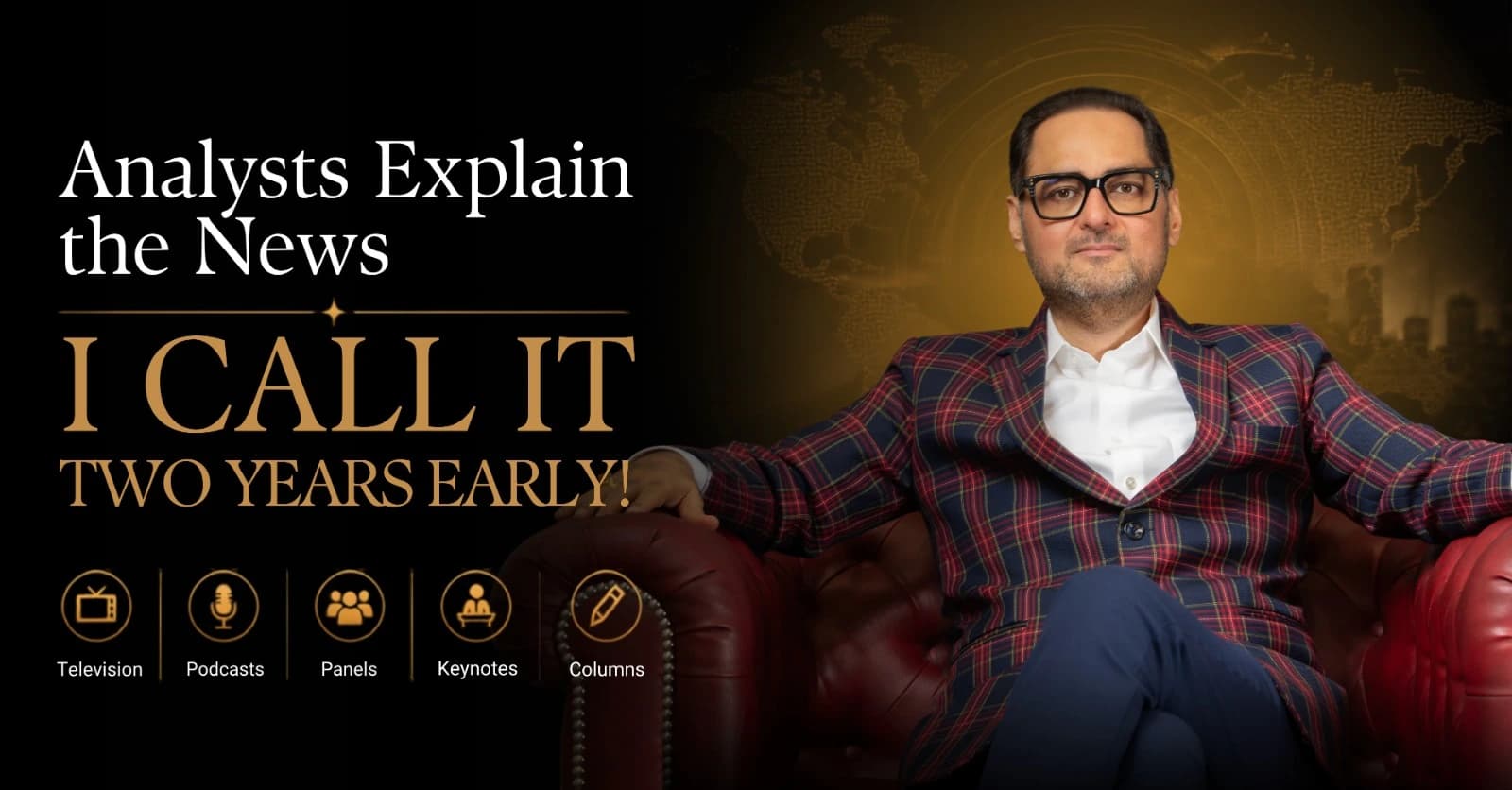
I am not an analyst. Analysts explain what happened.
I am usually on record before it does.













- CNN
- Gulf News
- The Wall Street Journal
- India TV
- The Republic TV
- NDTV India
- News Nation
- Zee TV
- Jaipur Dialogue
- PGurus
- Radio City
- Radio Mirchi
Analysts explain. I go on record first.
There is no shortage of people who can tell your audience why something happened. They are useful, and there are a great many of them — which is the problem. Your viewers have heard that panel before, and the retention curve shows it somewhere around minute twenty.
I work the other way round. The call goes on record, dated and on camera, and then the event either confirms it or it does not.
That is a harder position to hold. It is also a considerably more interesting one to book.
Public calls, made before the event
For an example of how country-level timing can shape an investment decision, read How to time an investment when the country is the risk.
- The US election — called two years early. The win. Biden replaced mid-race. Harris as the opponent. A risk to Trump's life in a named window — he was shot that day.
- Modi — called in 2012. BJP's candidate, the win, the full majority — before his name was in the conversation.
- Imran Khan — loss of power to the army, and jail. Said while he was still Prime Minister.
- Operation Sindoor — the May 14 window, and what followed.
All dated. All on camera. All checkable.
Two episodes from one recording
A dated call that lands is the cheapest content a channel can make. You run the claim. Later you run the confirmation.
Most guests cannot offer that, because most have nothing on record to point back at. Your back-catalogue gains a second life it did not have before the booking.
The same applies in print. A column that makes a call becomes a second column when the call resolves.
Angles you can pitch upstairs
Segment-ready. Each has been done on camera before.
- West Asia through Jyotiṣa — Iran, Israel, the Gulf, and what the timing says about the next window.
- The US power cycle — elections, leadership, and the years that turn.
- India's decade — politics, timing, and what the charts said before the results.
- Never bet against the UAE — stability, capital flows, and why the money keeps arriving.
- “How did you call that?” — the retrospective format: the original clip, then the working.
- The year ahead — an annual or quarterly forecast segment, recurring by design.
- What Jyotiṣa actually is — the explainer, for an audience that assumes it is fortune-telling.
Formats
Television panels
Live, opinionated, and comfortable being the dissenting voice on the panel.
Long-form podcasts
Sixty to a hundred and twenty minutes, studio or remote. Built for a conversation, not a soundbite.
Columns and print
Previously for the Wall Street Journal and Gulf News. Commissions welcome — a dated call in print carries the same two-for-one value it does on camera.
Keynotes and conferences
For founders, family offices and investor audiences.
Radio
Including drive-time formats.
Practical details
What I will not do
No fear content. No death predictions, no doom segments, and no readings of named individuals who have not consented.
If a format needs a guest who will frighten an audience for the ratings, I am the wrong guest.
That is precisely why serious channels book me.
Booking
Tell us your format, your date and your audience.
You will get a straight answer, quickly, either way.
The Monthly Note
One note each month with exclusive announcements, what I’m watching, and where the pressure’s building!.
Twenty Thousand Readers. Just One Click To Join!
This site is protected by reCAPTCHA and the Google Privacy Policy and Terms of Service apply.


You paid me with your time.
Time is the one currency nobody gets more of. You have spent some of yours here, and I do not take that lightly.
Two decades of this practice have been built on exactly that — people giving their attention first, and their trust afterwards. It is why there are clients and students in more than thirty countries.
Thank you. I hope it was worth the time.
All Rights Reserved @KaartikGorGlobal 2002-2026

